










.p3d - The Photo 3D File Format for the Real World

The .p3d (Photo 3D) format is redefining how products become interactive, intelligent 3D assets for ecommerce, gaming, and digital twins. With under 10 minutes from scan to publish, .p3d compresses photography, metadata, and 3D layers into a single capsule - ready for cloud, SDKs, and every device.
1.What is .p3d?
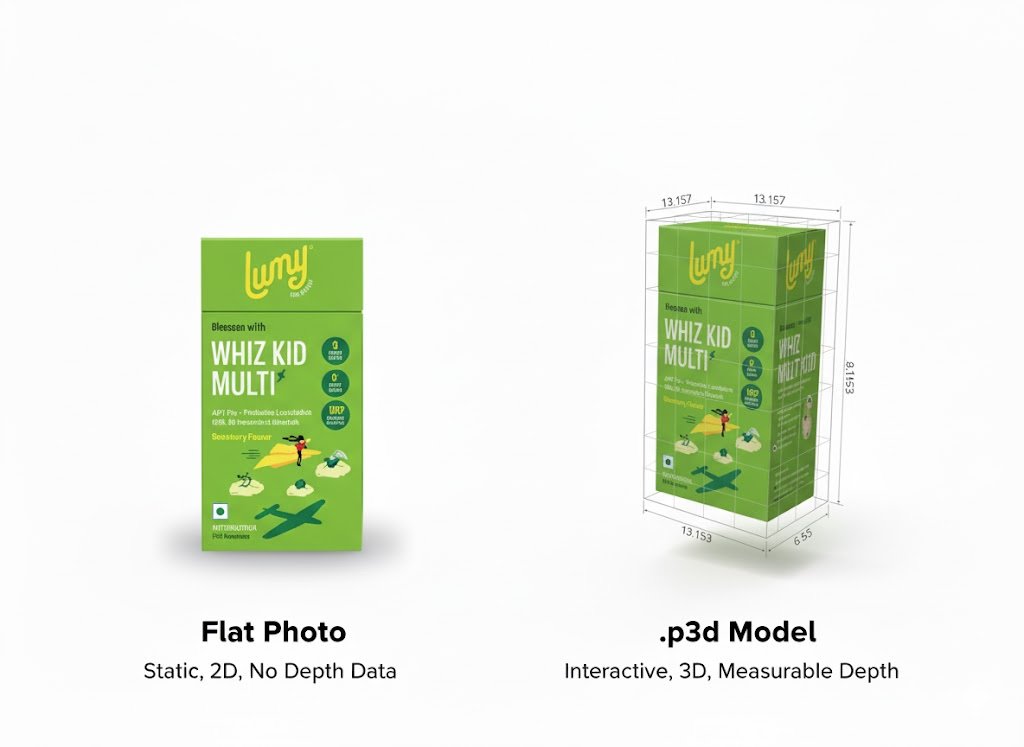
.p3d is a next-generation photographic-3D file format engineered to make any real-world product 'digitally tangible' with instant visual, spatial, and intelligent content. Each file includes:
-
📷 360° multi-angle imagery (36–72 frames, multiple elevations)
-
🧭 Depth maps + spatial data for real-world dimension
-
🧾 Full product metadata: SKU, barcodes, weight, color, texture
-
🎞️ Embedded turntable sequences and media
-
🗂️ Built-in compression + encryption for secure cloud streaming
🤖 AI layers for defects, reflections, surface characteristics
Every .p3d is a fully encapsulated, intelligent visual object - ready to transform commerce, content, and supply chain integration.
2.Why .p3d Over Legacy 3D?
P3D may not have the power of full-scale game engines, but it has carved out a niche for quick 3D prototyping, educational tools, and creative experimentation.
Legacy 3D vs Photo 3D (.p3d)
| Feature | Legacy 3D (OBJ/GLB/FBX) | Photo 3D (.p3d) |
| Creation | 3D modeling / LiDAR | Photo sequence |
| Processing Time | Hours–days | ~10 min |
| File Size | 50–300 MB | 5–25 MB |
| Visual Fidelity | Synthetic geometry | Photo-real |
| Integration | Needs 3D engine | Web/app native |
| Data Scope | Geometry | Metadata, AI layers, visuals |
.p3d brings turn-key 3D, combining the ease of photography and the muscle of spatial data—making product digitization scalable, accurate, and lightning-fast.
3.Plug-and-Play Platforms
-
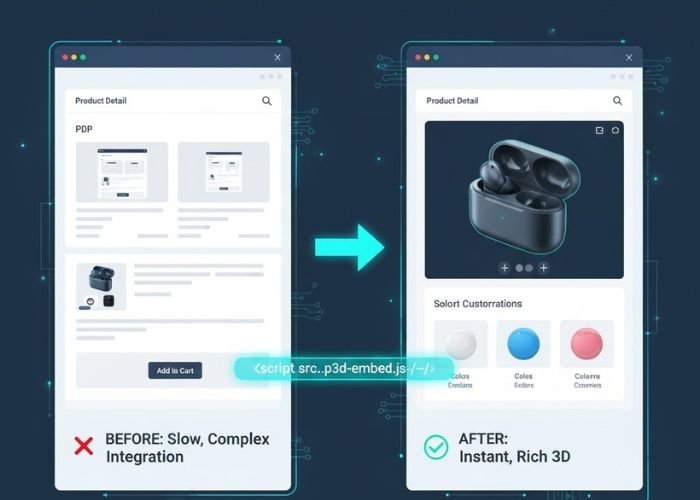
E-Commerce: Embed .p3d 360° viewers for instant product interaction (Amazon, Shopify, Walmart, ONDC)
-
Catalogs: Manage .p3d as a unified asset with thumbnails, depth, and specs
-
Game Engines & AR/VR: Import .p3d texture-depth to Unity/Unreal in minutes
-
Creative Suites: Layer and edit .p3d content in Photoshop, Blender, Premiere
Developers: HyperDisplay/HyperFlow SDK for instant embedding and live CMS streaming
“P3D let us ship full 360° PDPs without site rebuilds—instant spin, zoom, auto attributes, and catalog updates flowing from scan to marketplace in hours, not weeks.”

4.Scale & 3D Future
The 3D content economy is expanding 30%+ year-on-year. .p3d makes volumetric product scans as repeatable as any studio shoot - building a universal standard that bridges ecommerce, AR/VR, robotics, and digital twins.
Batch-automation, version safety, clean metadata for PIMs and catalogs, and full enrichment pipelines make product digitization resilient and market-ready.
5.Neural Vision - The P3D Engine
Where human vision is 2D, the P3D Engine uses neural networks to reconstruct dimension, motion, depth and context from photo sequences—mirroring how the brain perceives reality. This unlocks true spatial understanding for retail, robotics, digital humans, and next-gen XR.
-
Biological vision: 2D input, 3D perception
-
P3D Engine: Neural depth-from-photos, intelligent layer synthesis
3D isn’t geometry—it’s perception, context, and meaning. .p3d files capture exactly that.
6.Vision & Standardization
The full .p3d ecosystem—scanner, neural engine, SDKs—will set the JPEG standard for 3D, making digital twins effortless, interactive, and universal. One Scan. Ten Minutes. Infinite Possibilities.
Leave a Comment
Your email address will not be published. Required fields are marked *